
Your Post-Merger Integration Playbook: What to Do in the Next 100 Days
MERGERS & ACQUISITIONS SERIES
You're six months into integration. The synergy models look good. The org chart is finalized. The steering committee meets weekly.
But something's not right.
Your best product manager just gave notice. Customer complaints are up 22% but nobody can explain why. The key integration milestones keep slipping. And when you ask what's really going on, everyone says "we're on track."
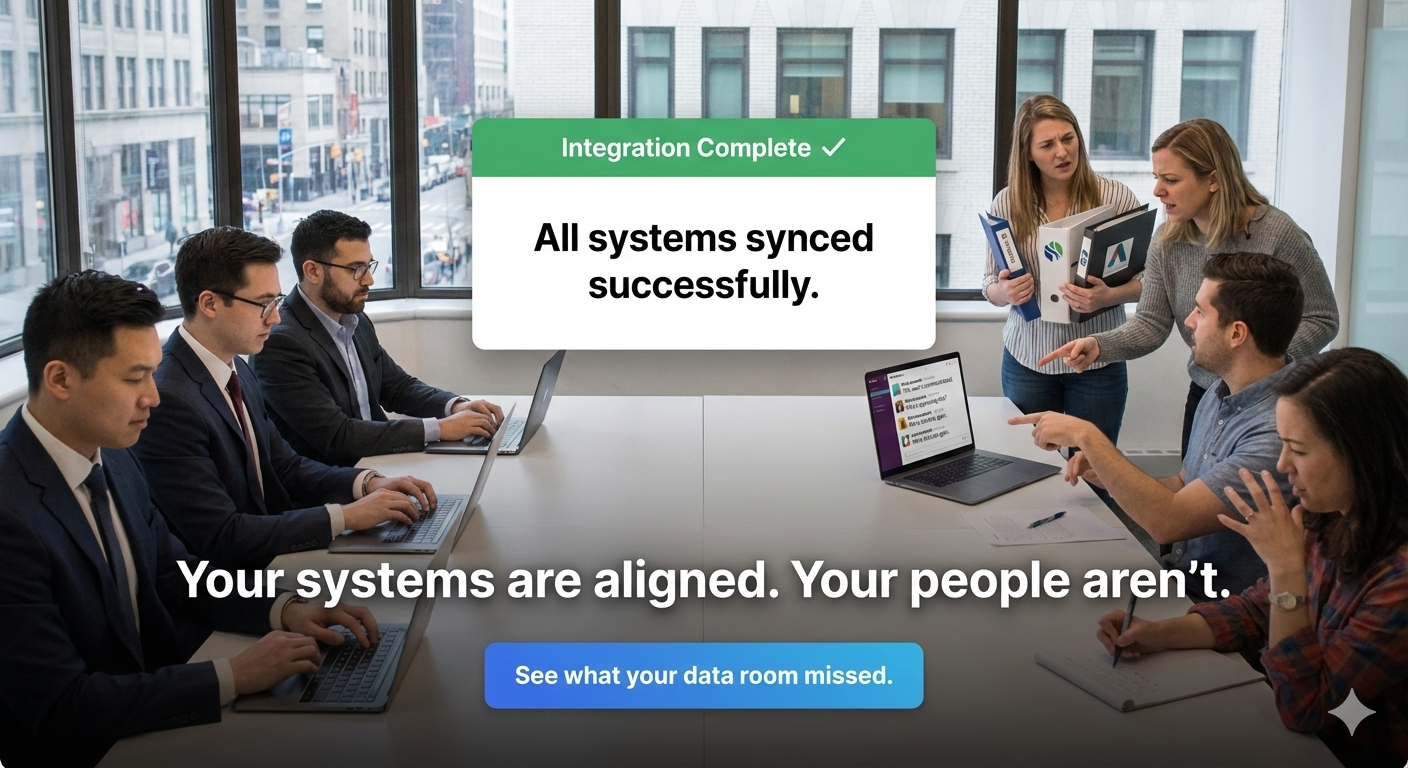
Here's what's actually happening: there's a canyon-sized gap between what you're hearing in meetings and what's happening on the ground. And by the time the real problems surface in your dashboard, millions in value have already walked out the door.
In this series, we've shown you the scale of M&A value destruction ($1.5 trillion annually), the hidden value destroyers (information silos, trust breakdowns, cultural misalignment), what the 14% who succeed do differently, and what your acquired employees are actually experiencing.
Now it's time for the playbook. If you're 6-12 months into integration—or planning your next deal—here's what separates preserving value from watching it evaporate.
The Critical Actions That Actually Matter
Based on what separates the 14% who succeed from the 86% who fail, here are the non-negotiables:
1. Map trust in real-time, not quarterly. Use pulse surveys to identify where trust is breaking down by role and team. But more importantly—act on what you learn within days, not quarters. Nothing destroys trust faster than asking for feedback and doing nothing with it.
2. Treat culture like you treat financials. You spent months on financial due diligence. Cultural due diligence can't be an afterthought. Assess actual behaviors, not aspirational values. Identify your non-negotiable behaviors from day one and hard-wire them into the operating model.
3. Protect the base business obsessively. Start every integration meeting with current business performance. 72% of successful deals avoided the year-one revenue dip versus only 33% of failures. No amount of synergies compensates for top-line disruption.
4. Communicate relentlessly. Weekly updates through multiple channels. If you feel like you're over-communicating, you're probably doing it right. Create closed-loop feedback where you publish the top 3 concerns raised and the specific actions you're taking.
5. Surface hidden risks before they're crises. Don't rely on sanitized steering committee reports. Deploy "fire spotters"—trusted influencers who gather ground truth. Create psychological safety for bad news. By the time a risk appears in your dashboard, it's already a crisis.
6. Invest in integration leaders like the deal depends on it. Because it does. Organizations with the right integration capabilities are 1.6-1.7x more likely to exceed synergy targets. Staff with your best talent, not whoever's available.
7. Make cultural integration a line responsibility. Successful integrators assign executive sponsors to own cultural integration as core business—not as an HR program. They budget 2-3% of deal value specifically for it. Remember: 60% of practitioners wish they'd spent more on culture.
The Ground Truth Problem
If you're serious about understanding what's really happening in your integration, you need to talk to people at every level.
Not scripted town halls. Real conversations. With the people considering whether to stay or leave. With the managers trying to execute in the messy middle. With the customers wondering if their account team still cares.
The ground truth is there. But here's the problem: people won't tell you the truth in a steering committee meeting. Or a town hall. Or even a one-on-one with their manager when their job security feels uncertain.
They'll say "we're on track" while updating their LinkedIn profiles. They'll nod along while the real issues fester. And by the time the problems surface, your best people have already made their exit plans.
The executives who preserve acquisition value create channels for unfiltered truth. But how?
Meet Your Integration Truth-Seeker
Think Wendy Rhoades from Billions—the performance coach who has confidential 1:1s with everyone, understands what's really blocking performance, and helps leadership make the critical decisions before things blow up.
That's what HaloVision does for integration leaders.
HaloVision conducts confidential 1:1 AI-powered calls with your people across both organizations. Not surveys. Not anonymous feedback forms. Real conversations where people can speak freely because they know:
- It's completely confidential
- The AI understands context and nuance
- Their input leads to action, not just data collection
- They're being heard, not interrogated
Here's what makes it different:
Within 48-72 hours of launch, you get your first critical insight. One pilot company prevented a $580K timeline slip in the first month because HaloVision surfaced a hidden blocker: the engineering team needed custom parts not in the spec, which required a design freeze. The VP raised it, but the team thought the directive was "proceed despite risk." HaloVision caught the misalignment before it became a disaster.
It finds the problems your steering committee won't. The CTO who's jumping into low-level decisions and creating communication triangles. The two senior engineers close to quitting because of burnout. The mismatch between exec promises (March 31 shipment) and engineering reality (August timeline). The debugging work that's underestimated by 3x.
It quantifies impact in dollars and runway. Not vague "employee sentiment scores." Actual business impact: $75K in runway saved here, $600K in retention costs avoided there, $1.2M in revenue protected.
It provides decision briefs, not just data dumps. You get a strategic focus brief with:
- The top priorities ranked by business impact
- Specific decision points with options and trade-offs
- Who needs to be involved and what actions to take
- Progress tracking on what's working
As one CEO put it: "Incredibly valuable, you're solving problems that could have exploded in my face!"
A VP Engineering said: "You're extracting information in a safe way that hasn't happened before."
How It Works for M&A Integration
Start with one team experiencing the most friction—typically 20-30 people across both organizations. HaloVision schedules brief 1:1 AI calls (they average 28 minutes even though scheduled for 15).
Within days, you see:
- Where trust is actually breaking down (not where you think it is)
- What information silos are killing productivity
- Which cultural clashes are driving attrition risk
- What hidden blockers are derailing your timeline
Then you act. HaloVision helps you create closed-loop feedback—people see that their input leads to visible decisions, which builds trust and unlocks even more truth.
As you solve problems, you expand to more teams. One robotics company expanded to all employees in 2 months after seeing results.
The Difference Between the 14% and the 86%
The difference between integrations that succeed and those that fail isn't luck. It's information.
The 86% who fail rely on org charts, steering committee reports, and the assumption that "no news is good news." They discover the truth too late.
The 14% who succeed create systems to surface reality before it becomes a crisis. They know that the biggest risks in M&A integration aren't in the financial model—they're in the unspoken friction that drives your best people to leave.
The truth about your integration is already there. HaloVision helps you hear it.
Schedule a Demo
Want to see how HaloVision surfaces the ground truth in your integration? Book a conversation with our team.
Book a confidential conversation with Halo →This Series
Part 2: Why Your Acquisition Is Bleeding Value (You are here)